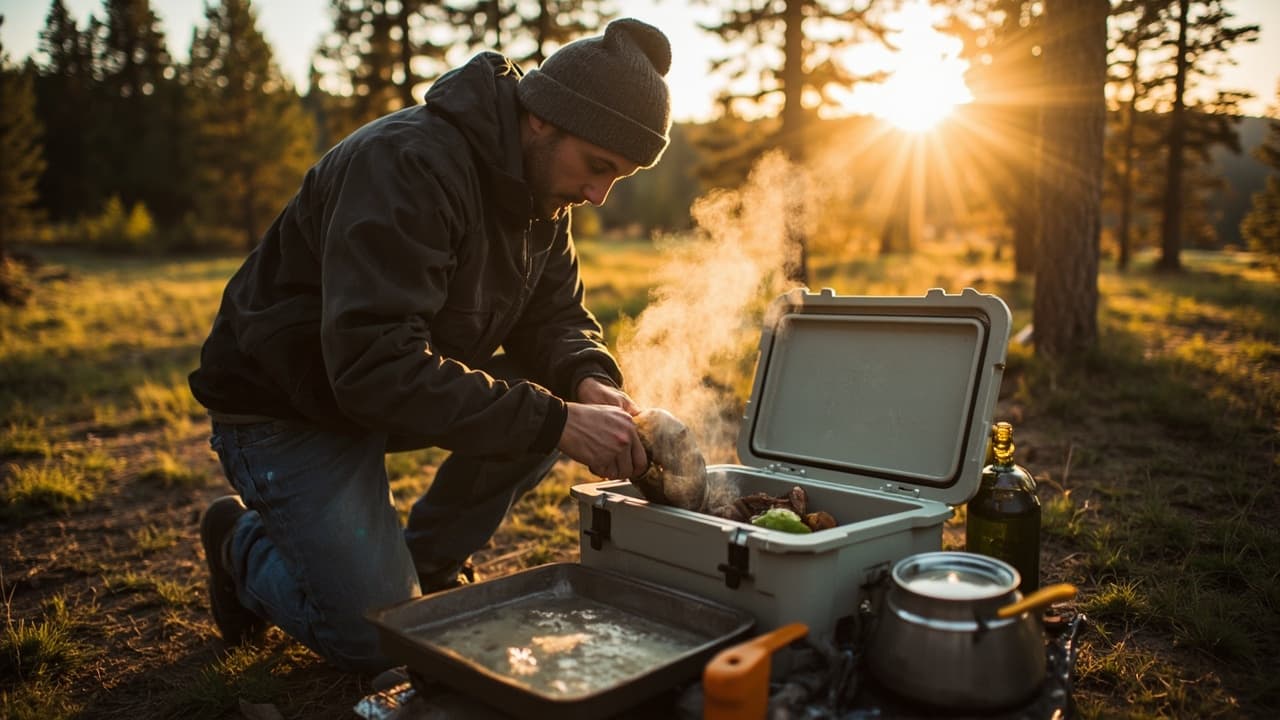
Learn a layered ice strategy that outperforms a pricier cooler, from pre-chilling and block ice to sun, lid, and packing habits that protect food all weekend.
How to Keep Food Cold Camping — Ice Strategy, Not Just a Better Cooler — Quick Comparison

RTIC 52 QT Ultra-Light Hard Cooler

GoCJ Arizona Ice Large Industrial Ice Packs

Titan by Arctic Zone Deep Freeze Cooler

Cool Coolers by Fit & Fresh 4 Pack XL Slim Ice Packs

Healthy Packers Ice Packs for Lunch Boxes & Coolers

Igloo Maxcold Ice Block
Prices and ratings last checked Oct 12, 2026 and can change at any time. Confirm the current price on Amazon before buying.
A new cooler buys you a handful of hours. A real ice strategy buys you the whole weekend. The difference comes down to what you freeze, how you layer it, and how you treat the cooler like a piece of equipment instead of a magic box. This guide walks through how to keep food cold camping without overspending, then points to the gear that actually pulls its weight when the thermometer climbs.
Why Most Coolers Fail Before the Ice Does
The single biggest mistake campers make is treating their cooler like a refrigerator. A cooler is an insulated box, and insulation only slows heat transfer; it does not stop it. Every time you crack the lid, you trade ten or fifteen minutes of cold air for a rush of warm air. Every time you set the cooler in direct sun, you pile more heat on the side facing the sun. Every time you bury a hot sandwich inside next to a cold drink, the sandwich warms the drinks.
Long cold holds come from reducing these three losses: openings, sun, and thermal bridging. The cooler is the container. The strategy is the system.
How to Choose a Cold-Holding Setup
Match the system to the trip, not the other way around.
Trip length matters more than cooler size. A one-night car camp with a grocery run on the way home barely needs any ice. A three-day river trip where resupply is impossible needs serious thermal mass. For weekend trips, a medium hard cooler plus a few reusable ice packs handles almost everything. For a full week off-grid, stack two coolers — one for drinks you crack open, one for food you keep sealed.
Hard vs. soft. Hard coolers hold cold longer because the walls are thicker and the seals are tighter. Soft coolers are easier to carry and stash behind a seat, but they bleed cold faster and rely heavily on what you freeze. For food safety on a camping trip, hard is the safer pick.
Ice type drives results. Cubed ice melts fast and chills drinks quickly but disappears by Saturday morning. Block ice lasts two to three times longer and is the backbone of any long-hold strategy. Reusable ice packs add thermal mass without the slush, and slim packs slide into gaps between jars and cans where loose ice would never reach.
Pre-chill everything. A cooler full of warm food and warm drinks has to spend its first six hours just chilling down. Pre-chill the cooler with sacrificial ice the night before, freeze your reusable packs solid, and load food that has already been refrigerated. Cold going in means cold for days.
Shade and surface. Set the cooler in shade, on a flat surface, with a blanket or reflective cover over the lid. Direct sun on a dark lid will cook the contents even when the air is cool. A cheap reflective sun shade or a piece of foam camping pad on top of the lid works wonders.
Open it like it owes you money. One full reorganization per meal. Get everything out, put it back, close the lid. Resist the urge to graze.
The Picks
RTIC 52 QT Ultra-Light Hard Cooler
A 52-quart hard cooler that weighs noticeably less than rotomolded competitors at the same capacity. For weekend car camping, 52 quarts holds a couple of days of food plus drinks for two to four people without overpacking. The lighter shell is easier to lift into a truck bed and easier to wrestle onto a picnic table.
The trade-off is raw cold-hold time compared to a thick-walled rotomolded cooler. With smart ice strategy — block ice on the bottom, frozen food in the middle, drinks on top — it easily handles a full weekend. Without that strategy, you will be at the store Saturday morning. Treat it as a partner in a system, not a standalone miracle.
Check the RTIC 52 QT Ultra-Light Hard Cooler on Amazon
GoCJ Arizona Ice Large Industrial Ice Packs
A two-pack of large flat ice packs rated to 18°F, sized roughly 12 by 9 inches. These are the workhorses for long holds. Lay one flat on the bottom of the cooler before loading, slide the second between layers of food, and they act as thermal mass that does not turn into meltwater.
The "industrial" sizing means they cover a lot of surface area, which is exactly what you want. Wider contact with food pulls heat out faster and keeps the interior closer to freezer temperature. They also stack neatly, so you can build layers instead of dumping everything into a pile.
Check the GoCJ Arizona Ice Large Industrial Ice Packs on Amazon
Titan by Arctic Zone Deep Freeze Cooler
A zipperless hardbody cooler with a smart shelf on top for dry goods and a deep freeze liner in the main compartment. The zipperless top is the selling point for campers tired of fighting a stuck zipper when their hands are cold or wet. You crack it like a chest, the lid stays where you put it, and the seal reseats cleanly.
The internal shelf is useful for separating bread, fruit, and snacks from the icy zone below. That separation matters more than people realize: soggy bread and bruised tomatoes are usually a layering problem, not a cooler problem. For car camping where you want quick access to lunch items, the shelf saves real time.
Check the Titan by Arctic Zone Deep Freeze Cooler on Amazon
Cool Coolers by Fit & Fresh XL Slim Ice Packs
A four-pack of slim reusable ice packs designed to slide into tight spaces where bulkier packs cannot fit. Use these to fill the gaps around jars, between cans, and along the walls of the cooler. Loose ice would skip right past those gaps; slim packs sit in them and pull double duty as insulation and refrigerant.
The slim profile also makes them ideal for personal lunch boxes and day-trip bags. If you split off for a hike and want a sandwich and a drink to stay cold until lunch, a couple of these in a soft cooler or backpack work better than a fistful of cubed ice that will be water by noon.
Check the Cool Coolers by Fit & Fresh 4 Pack XL Slim Ice Packs on Amazon
Healthy Packers Ice Packs for Lunch Boxes & Coolers
Long, slim reusable ice packs that match the shape of standard coolers and lunch bags. The elongated profile lets you line the bottom and walls of a cooler with continuous cold instead of stacking fat rectangles that leave gaps. Lay one along each long wall, one across the bottom, and you have an ice-packed sleeve around your food.
These are also handy as emergency backups. Freeze a few extras in the hotel freezer or a friend's freezer on a road trip, and they go in the cooler for the next leg. Buying reusable packs costs more than a bag of cubed ice but pays back across every trip of the season.
Check the Healthy Packers Ice Packs for Lunch Boxes & Coolers on Amazon
Igloo Maxcold Ice Block
A pair of solid ice blocks designed to outlast cubed ice by a wide margin. Block ice is the secret weapon of long-hold cold. While cubed ice melts in hours and disappears as drink dilution, a block releases cold slowly and steadily. Two blocks laid at the bottom of a hard cooler create a cold floor that keeps everything above it in the safe zone.
The practical move is to freeze these at home well before the trip, ideally a couple of days ahead so the freeze is solid all the way through. A half-frozen block collapses halfway through Saturday. A fully frozen block is still working on Sunday morning.
Check the Igloo Maxcold Ice Block on Amazon
Verdict
If you want the best return on a small budget, skip the cooler upgrade for a moment and buy a pair of large flat ice packs plus a couple of block ice substitutes. Freeze them solid, pre-chill the cooler, and pack in layers. That single change can double your cold-hold time without touching the cooler at all.
If you are buying a cooler, pick the size that fits the trip — not the size that impresses on the driveway — and pair it with a mix of large flat packs for thermal mass and slim packs for gap-filling. Food storage is one area where being deliberate pays off at every meal.
Related guides: Best Coolers Under $100: Cheap Camping Coolers That Hold Ice (2026) · 7 Days of Budget Camping Meals — $50 Total Food Budget · How to Camp in Hot Weather Without Melting — Fan, Hydration, and Shade Strategies
Keep reading